

AI answering machine: how it differs from voicemail
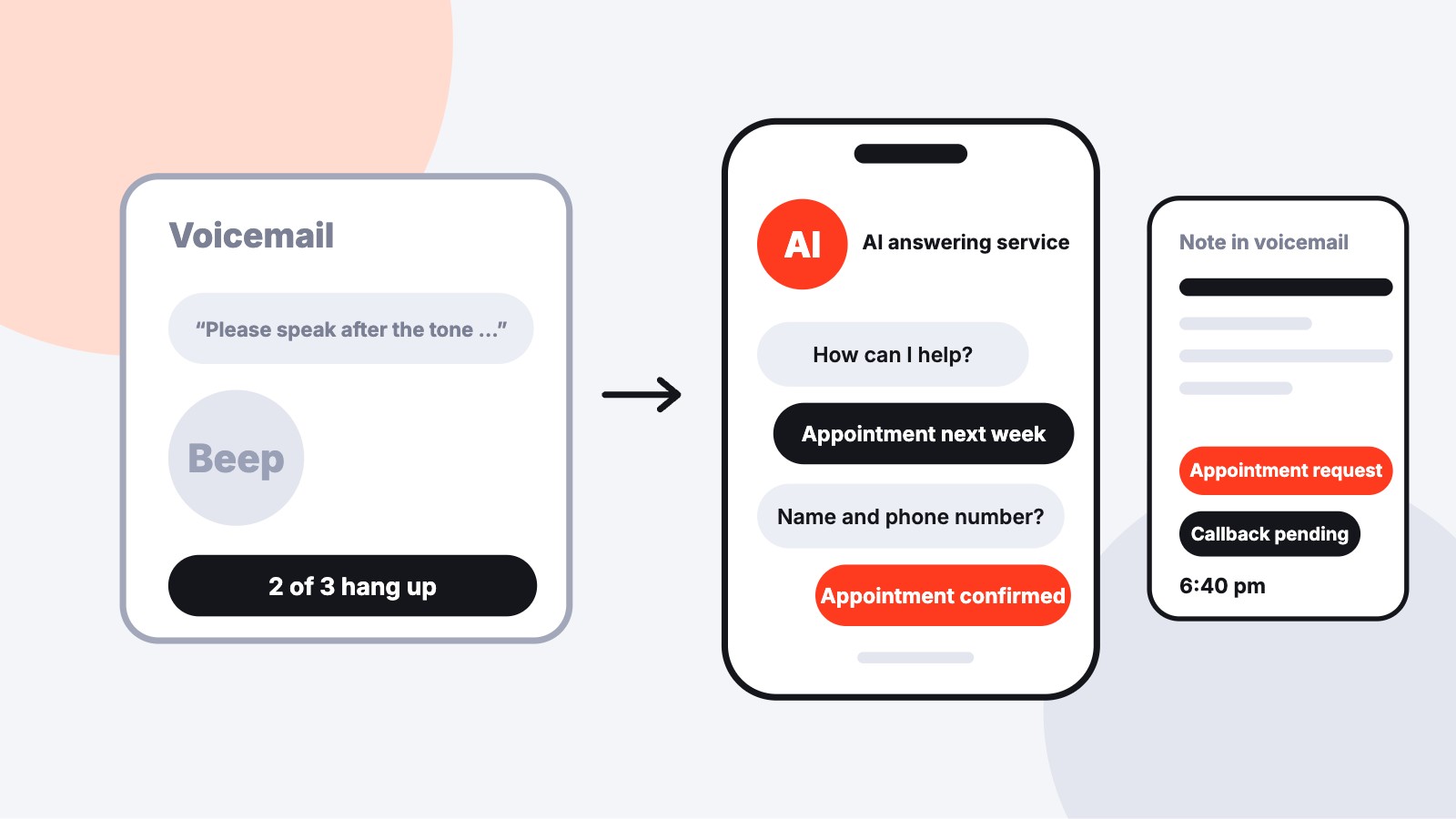
An AI answering machine answers calls, asks follow-up questions, sorts the request and sends you a written summary by email, even in the evening and on weekends. Whether this pays off for your business depends on your call pattern, the wording of your greeting and properly clarified data protection with the provider.
What an AI answering machine does on the phone that voicemail can't
Voicemail records, the AI answering machine asks follow-up questions. It captures name, callback number and request in a structured way and, depending on the setup, can book appointments or forward emergencies. The difference is clearest when you look at the same call.
Tuesday, 6:40 p.m., the office is closed. A customer calls because she needs an appointment next week. With voicemail, she hears the beep, rushes through a few sentences and forgets the callback number, or hangs up right away. That is exactly what around two in three callers do with a classic voicemail. The next morning you listen to the message, look for the number in the call log and end up on a voicemail yourself when you call back.
With an AI answering machine, the same call plays out as a dialogue. The assistant greets the customer, asks for her name and reason for calling, offers a free appointment and confirms it. When you check your inbox the next morning, a finished note is waiting there, not an audio snippet.
Technically, every conversation follows the same chain:
- The assistant answers the call and greets the caller with your welcome message.
- It converts what was said into text using speech-to-text, meaning a machine-readable transcript.
- It recognizes the intent behind the sentence, such as an appointment request, a callback request or a question about opening hours.
- It generates a suitable answer or follow-up question and speaks it with a synthetic voice.
- After the call, it documents name, phone number and reason for calling and forwards the note to the responsible team.
For your business, this means: the callback pile shrinks to the cases that really need a human, and each of them comes with context.
Keep your number: setting up call forwarding for landline, mobile and cloud phone systems
Your number stays the same, and callers dial as usual. The AI answering machine sits behind a call forward: your phone provider forwards calls under defined conditions to a destination number that you receive from the AI provider. With a clean setup, the assistant sees the caller's original phone number, so callbacks are matched correctly.
On mobile, forwarding works via standardized GSM codes, which you enter directly on the keypad. They work regardless of network with Telekom, Vodafone, o2 and their resellers.
| Forwarding | Activate | Deactivate | Use |
|---|---|---|---|
| Immediate, all calls | **21*destination-number# | ##21# | At night or on weekends |
| If unanswered (delayed) | **61*destination-number**20# | ##61# | Team gets the first chance, adjustable from 5 to 30 seconds |
| If busy | **67*destination-number# | ##67# | Second call during a conversation |
| If unreachable | **62*destination-number# | ##62# | No signal, battery dead, device off |
| Check status | *#21# (or *#61#, *#67#, *#62#) | n/a | Check after setup |
| Delete all forwarding | n/a | ##002# | Complete restart |
Landlines and cloud phone systems have no keypad codes. There you set up the forwarding in the customer portal of your provider or in the web interface of the system. On the FRITZ!Box, you will find the option under “Telephony”, then “Call handling”, tab “Call forwarding”. If you use a cloud phone system, you can usually store time-based rules directly, such as “from 6 p.m. to the assistant”.
As a starter setup, a combination of delayed forwarding and forwarding when busy works well. Your team still answers first, and the assistant only takes the calls that would otherwise have ended up in voicemail. For the delay, 15 to 20 seconds is a good value, corresponding to four to five rings.
Pitfall, voicemail timing: If the factory voicemail is set to a shorter ring time than your new forwarding rule, it grabs the call before the assistant gets a chance. Turn off the voicemail or set the forwarding to the assistant to a shorter time, and check the result with a test call.
Who benefits from switching and when voicemail is enough
An AI answering machine pays off if you regularly miss calls and most of them follow the same pattern. If instead you get few calls, each of them a complex individual case, a well-worded voicemail greeting often serves you honestly well.
| Your situation | Recommendation |
|---|---|
| Many calls after 5 p.m. and during the lunch break | AI answering machine on a schedule outside opening hours |
| Phone rings while customers are standing at the counter | Delayed forwarding plus forwarding when busy |
| Recurring questions about opening hours, appointments, callbacks | AI with appointment booking and stored standard answers |
| Few calls per day, each an individual case | Voicemail with a clear greeting and callback promise |
Industry solutions show what concrete use cases look like. The AI phone assistant for property management from ScaleTalk answers calls around the clock, classifies emergencies and forwards them to the emergency service, takes damage reports and transfers to case handling. The version for car dealerships and auto repair shops books appointments for tire changes, vehicle inspections (HU/AU) and servicing and answers status questions about the vehicle.
On costs, SMB plans for AI phone assistants typically fall in the two- to three-digit euro range per month (as of 2026). The price is driven mainly by the included call minutes, features such as appointment booking and calendar integration, the number of phone numbers or locations, and custom integrations with your software.
How callers really react and what a good greeting sounds like
Callers are divided: for clearly defined tasks they use AI on the phone, while for urgent or personal matters they want a human. A representative YouGov survey for the MUUUH! Voice Study 2026 with just over 2,100 respondents shows both at once. Half perceive voice assistants on the phone as a roadblock, while 71 percent can imagine using an AI phone agent for specific tasks.
For local businesses, AI on the phone is no longer uncharted territory. According to a GfK study commissioned by Greven Medien more than 44 percent of respondents had already had contact with AI-supported customer service at medical practices, restaurants or salons. About half praise easier appointment scheduling and availability outside opening hours.
The limit lies in complexity and urgency. In a survey of 100 industry experts by Spitch AG 55 percent view it positively to be connected directly to an AI agent without a waiting queue. However, 71 percent still want to speak to a human for personal or complex matters. German callers are more skeptical than the international average: according to a YouGov survey commissioned by Zendesk among around 10,000 respondents in ten countries, 61 percent of Germans want a human for urgent matters, compared with 55 percent globally.
For your greeting, this means: first say that a digital assistant is speaking, then what it helps with, and offer the way to a human. The AI disclosure belongs at the start of the call and is spoken; a note on the website doesn't reach the caller on the phone.
Greeting to adopt:“Good day, this is the digital assistant of Dr. Muster’s practice. I’m happy to take your request or help you book an appointment. If you would rather speak to a staff member, just say so and I’ll connect you.” For a repair shop, replace the appointment booking with “I’ll note your vehicle and your request so the master mechanic can call you back with the right information”.
The greeting then sounds like good service because it gives the caller a choice. For damage reports, medical questions or emergencies, the assistant also needs firm handover rules to a human.
GDPR questions you should ask your provider
An AI answering machine can be operated in a GDPR-compliant way if the legal basis, contract, transparency and storage are settled. GDPR requires a legal basis under Art. 6, informing callers under Art. 13 and consent before every recording. Clarify these points with the provider before signing:
- Where does the provider process and store the calls: in Germany, in the EU or outside?
- Does it provide a data processing agreement under Art. 28 GDPR, including a list of subprocessors?
- Does the assistant announce verbally right at the start that callers are speaking with an AI system?
- Does the system obtain consent before every recording, or does it work without recording?
- How long are recordings and transcripts stored, and can you set deletion periods yourself?
On top of GDPR comes a second obligation: the spoken AI disclosure. The EU AI Act applies directly in Germany, without needing a separate German implementing law. Since August 2, 2026, its Art. 50 has also obliged every German business that uses an AI phone assistant: callers must be able to tell that they are speaking with an AI system. A mere "Welcome to ..." is not enough, and neither is a note in the privacy policy alone.
With the data processing agreement, it is worth looking at what you are signing.
In brief:The data processing agreement (DPA) stipulates that the provider processes the call data only on your instructions and which protective measures it uses to do so. Toward callers, you as the business remain responsible.
Medical practices, law firms and notary offices need additional care. Health data and data of professional-secrecy holders count as special categories of personal data under Art. 9 GDPR. Increased requirements apply to them, such as an explicit DPA and additional technical and organizational safeguards. Therefore define what content the assistant asks for at all: name, callback number and type of request are often enough, and a human then clarifies the details.
The ScaleTalk AI phone assistant is GDPR-compliant and runs on servers in Frankfurt, developed in Germany. It is available around the clock and can be set up in about 30 minutes without programming skills.
What happens with emergencies, outages or a request for a human
If a caller wants to speak to a human, the assistant connects them live to a stored staff number or creates a callback task with context. Which route applies is determined by rules you set, such as “transfer during opening hours, otherwise callback the next morning”. For real emergencies, the greeting names the emergency number or forwards to an on-call service before the assistant asks for anything else.
A defined fallback helps with outages. GSM codes run on the mobile network and also work if the internet in the office goes down. Ask your provider where calls go if the assistant itself is unreachable, and set a voicemail or a work mobile as the destination.
The lowest-risk start is forwarding at night and when busy, with your team answering as before during the day. Before setup, you should have ready:
- Opening hours and holiday arrangements
- The five to ten most common questions with your answers
- Access to your calendar or appointment system, if the assistant is to book appointments
- The inbox or the person who receives the call notes
Then call your own number and deliberately don't pick up. That way you hear the greeting, follow-up questions and summary yourself before a customer experiences the assistant.
The small first step to a calmer phone line
The real lever lies in a single decision: start with forwarding at night and when busy. That way nothing changes for your regular customers during the day, and after a few weeks you can see from the call notes how many inquiries were lost before. Your next step is a test call to your own number before you enable the forwarding for real callers. If the greeting sounds like your business and the note arrives complete, extend the hours step by step.
Frequently asked questions about the AI answering machine
The feature set makes the difference; the terms overlap a lot. An AI answering machine mainly takes down requests and sends notes. An AI phone assistant also books appointments, answers questions and transfers calls to the right team members.
The same way you activated it: on mobile with ##61#, ##67# or completely with ##002#, on landline and in a cloud phone system via the portal. After that, only your phone rings again, and unanswered calls go to voicemail.
You correct the stored standard answer, and the assistant answers correctly on the next call. To do this, review the call notes regularly in the first few weeks and add questions that come up more often than expected.
From the call notes: count how many calls the assistant answered outside team hours and how many appointments or callback requests resulted. Compare that with the voicemail messages and evening callbacks from the weeks before launch.
A new forwarding rule of the same type usually overwrites the old one; other types stay active. Check the status with *#21#, *#61#, *#67# and *#62#. If you want a clean restart, delete all forwarding rules first with ##002#.
Yes, via the call summaries and, depending on the system, via transcripts in your inbox or customer portal. Define how long this data is stored so that control and data protection go together.
Instead of voicemail: try the ScaleTalk AI answering machine now
AI telephony for practices, repair shops, law firms and agencies, set up in a GDPR-compliant way. Servers in Germany.