

Voice Agents for SMEs: Features, Costs and Providers 2026
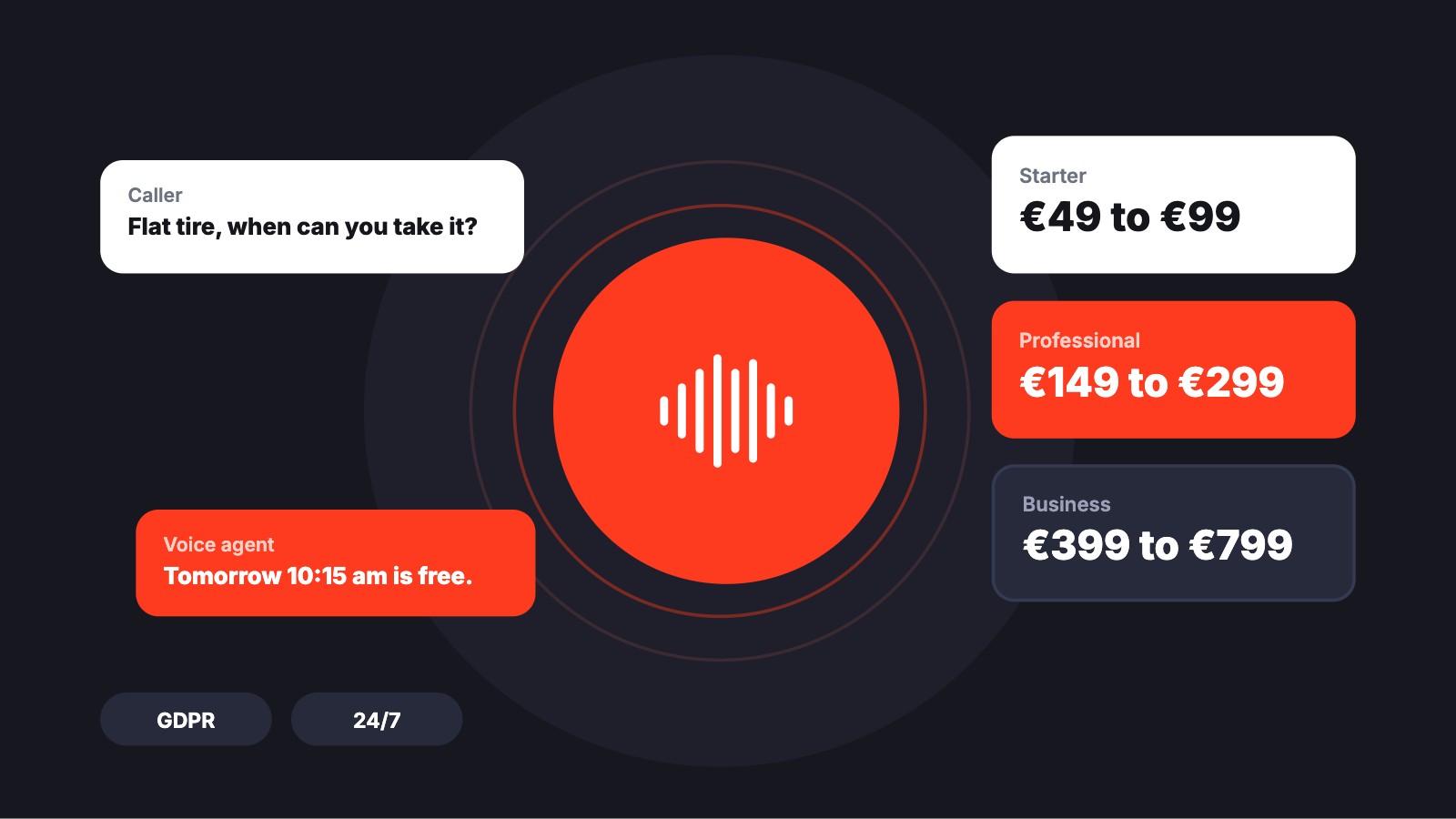
A voice agent is an AI phone assistant that answers incoming calls in natural language, handles routine requests itself and transfers the result directly into the calendar, CRM or ticketing system. Small and mid-sized businesses set it up without programming skills and are thus reachable even outside opening hours.
What a voice agent really takes over on the phone
The AI phone assistant answers incoming calls around the clock and handles the requests that follow a fixed pattern. In typical hotline scenarios, that is 50 to 70 percent of calls, mainly appointment requests and status inquiries. On top of that comes lead qualification, meaning pre-sorting new inquiries by need and urgency before a human takes over.
At a medical practice, a patient calls at 7 p.m. and wants to order her repeat prescription. The agent asks for name and date of birth, notes the medication and confirms the pick-up time by SMS. Doctolib's phone assistant recognizes accents and dialects, distinguishes new from known patients and enters appointments directly into the practice calendar. In an emergency, the AI stops and connects immediately to a medical assistant.
At a car workshop, a customer calls with a flat tire and asks when he can come by. The agent checks the free slots in the workshop calendar, books the next suitable appointment and mentions a loaner car if the workshop offers one. The master mechanic at the lift keeps working without interruption.
At an insurance agency, a customer reports accident damage. The agent takes the claim number, contact details and accident location and hands the case over in a structured way to the responsible case handler. If someone asks the same evening about disability insurance, the agent captures occupation and callback request and creates a consultation appointment.
Its limit lies where judgment or empathy is needed. A symptom assessment by the system would be legally delicate, tariff advice weighing risks remains the broker's job, and an upset customer needs someone who listens.
What does a voice agent cost per month?
Small and mid-sized businesses typically pay €69 to €199 per month plus €0.15 to €0.50 per call minute. According to provider information, the overall market range runs from €29 to €500 (as of July 2026). Where your business lands is decided mainly by the included minutes (the call allowance included in the package) and the number of connected systems.
Typical for the German market is tiering by business size:
| Package | Typical target group | Base fee per month | Included minutes |
|---|---|---|---|
| Starter | Micro business, solo practice | €49 to €99 | 200 to 500 |
| Professional | SME | €149 to €299 | 1,000 to 3,000 |
| Business | growing SME | €399 to €799 | 5,000 to 10,000 |
| Enterprise | Mid-sized company | from €1,200, custom | by agreement |
For a solo medical practice, it looks like this: €500 one-time setup, €79 for a Starter package and around €30 in call costs at roughly 300 minutes per month. Ongoing, that costs €109 per month. 300 minutes roughly equal 100 calls of three minutes. Choose the package whose included minutes cover your real monthly volume. If you regularly exceed it, compare the next larger package.
Solutions custom-developed by agencies are in a different class: €5,000 to €30,000 one-time plus ongoing support. That only pays off with complex requirements such as integrating several channels.
Costs at call peaks: Before signing, ask what a minute above the allowance costs and whether calls go into a queue under overload or are automatically billed at a higher rate. In a month with a flu wave or hail damage, exactly this point decides the bill.
Which providers fit which business size?
The first fork is your industry: medical practices benefit from specialist providers with a connection to practice software, while workshops, agencies and law firms usually do well with a cross-industry system that can be adapted to their workflows. Business size then decides the package.
In healthcare, Aaron.ai, which belongs to Doctolib, is one of the best-known German providers. The system runs in over 3,000 practices, is trained on medical terminology and connected to practice management systems such as Medistar or CGM. It is only available, however, in the Doctolib "Patient Management" package with an annual subscription, and it speaks only German with one voice.
Cituro takes a broader approach: the phone assistant targets businesses from the trades to hospitality, is more flexibly configurable and connects to Google Calendar and Microsoft 365. For solo self-employed people and small businesses, it is typically €17 to €47 per month.
For car workshops and insurance agencies, there are hardly any specialist providers with published industry pricing. Cross-industry platforms from Germany come into question here, such as fonio.ai or ScaleTalk. ScaleTalk explicitly targets workshops, insurance brokers, trade businesses and real estate companies: the agent answers calls around the clock, books appointments and pre-qualifies inquiries, such as a damage report or a workshop appointment.
Regardless of industry, these criteria decide the choice:
- Test German voice and speech recognition with surnames and technical terms.
- Check integrations with calendar, CRM or practice software.
- Clarify setup effort: on your own or by the provider.
- Fix the contract model with term, cancellation and billing in writing.
- Secure the portability of your phone number and call data contractually in case of a provider change.
Data protection: which points to clarify before signing?
Use is sound under data protection law when four points are settled contractually and technically. If you process health, client or insurance data, a fifth is added. These points apply to every provider, regardless of price and size of the system.
In brief: The data processing agreement, DPA for short, regulates how a service provider processes, protects and deletes personal data on your behalf. If it is missing or incomplete, that alone is already a GDPR violation.
Ask about these points in your conversation with every provider:
- Sign the DPA before the first live call, with a retention period for call data of no more than six months.
- Request the EU server location and the list of all sub-processors in writing.
- Contractually exclude your calls from being used for AI training.
- Place a spoken AI disclosure at the start of the call, before the first substantive answer.
- For health data or professional secrecy under Art. 9 GDPR, record the protective measures in the DPA.
The list of sub-processors shows whether US services for speech recognition or speech output run in the background that are subject to the CLOUD Act.
The AI disclosure is a separate obligation alongside the GDPR. Since August 2, 2026 Art. 50 of the AI Act, which applies directly in Germany, requires that callers learn they are speaking with an AI. The obligation applies to every business regardless of its size, namely the company that deploys the assistant, even if the provider supplies the technology. A sentence such as "Hello, I'm the AI assistant of [company name]" at the start of the call is sufficient.
ScaleTalk operates its servers in Frankfurt, is developed made in Germany and describes the platform as 100% GDPR compliant. As with any provider, have the DPA and the list of sub-processors presented to you. The checklist does not replace legal advice: whether a fine is a risk in an individual case, clarify with your data protection officer.
Setup without programming skills: process and duration
For setup, you need neither programming skills nor your own IT department. With ScaleTalk, the basic setup is done after a few minutes. Preparing the content and a clean test phase take more time, for which you should plan a few days.
- Store opening hours, services and the most common caller questions as a knowledge base, often taken directly from your own website.
- Define which requests the agent handles itself and which it forwards to whom.
- Connect calendar and CRM so appointments and inquiries land in the system without retyping.
- Set up call forwarding that passes on calls when busy, unanswered or at fixed times.
- Everyone on the team calls once with a typical and a difficult request.
- Go live, initially only outside opening hours, then gradually extend to peak times and the lunch break.
The business contributes the content, access to the calendar and a person who reviews and fine-tunes the call logs in the first weeks. You usually keep your phone number in the process. If you want to move to a cloud phone system anyway, with fonial you will find a system with skill routing, queues and native ScaleTalk integration from €3.90. Starting outside opening hours is also the lowest-risk test: you see how callers react without day-to-day operations depending on it.
Does a voice agent pay off compared with an answering service and a receptionist?
An AI phone assistant costs a typical small business a fraction of its own receptionist and stays more predictable as volume grows than an external answering service, because the monthly subscription includes a fixed minute allowance. With very few calls, a human secretarial service can be cheaper. Virtual secretarial services such as ebuero or starbuero.de bill per call or minute, starbuero.de with no base fee at all.
| Option | Cost per month | Availability | Fits when |
|---|---|---|---|
| Voice agent | €69 to €199 plus €0.15 to €0.50 per minute | around the clock | roughly 30 to over 500 calls per month |
| External answering service | €0 to €59 base fee plus €0.49 to €1.99 per call or minute | depending on plan, costs rise with every call | roughly 10 to 60 calls per month |
| Full-time receptionist | around €3,800 to €4,700 including non-wage labor costs | Mon. to Fri., 8 a.m. to 5 p.m., absent during vacation and sick leave | personal reception on site |
| Voicemail with callback | usually included in the phone plan | Message at any time, conversation only on callback | few, non-urgent calls |
A voicemail costs nothing, but doesn't catch lost revenue. At medical practices, 62 percent of callers who reach the answering machine hang up without leaving a message, and around two thirds turn to another practice after an unsuccessful call.
The measurable effect shows mainly in time gained. At a medical practice, an AI phone assistant wins back around 1.8 hours of phone time per day for direct patient contact at reception. How much such a system catches at scale is shown by a case from another industry: in Riverty's German debt collection business unit, a voicebot developed with Parloa handles 37 percent of the total call volume. After a pilot phase in e-commerce since July 2024, the system has handled over 100,000 calls.
Two ScaleTalk customer projects provide further figures, both manufacturer claims and two separate cases. At the Orthodentix dental practice, callback effort fell by around 70 percent. In the pilot project at AXA MB GmbH, an independent AXA agency, the team says it saves around 120 hours of phone time per month.
For a trade business with 15 employees, an approximate calculation from the market gives the following picture: the agent costs €529 per month. If it saves just two of five otherwise lost jobs, that brings €1,600 in revenue, an ROI of over 200 percent in the first month. Your calculation: missed calls times close rate times order value, minus the monthly costs.
Limits of the voice agent: what gets handed to humans
The agent hands over to a human as soon as a conversation requires judgment, empathy or immediate action. You set these cases as fixed handovers before the start:
- Emergencies such as acute complaints or a burst water pipe.
- Complaints and emotionally charged conversations.
- Questions involving symptom assessment or individual advice.
- Comprehension problems despite follow-up questions, for example due to a poor connection or dialect.
Especially with a poor connection or strong dialect, a fixed rule helps so that nobody goes in circles.
Rule of thumb for handover: If the agent doesn't understand a request after two follow-up questions, it transfers the call or takes a callback request. That way no caller gets stuck in a loop.
Typical rollout mistakes are organizational. If the knowledge base stays unchanged after launch, the agent gives wrong opening hours on public holidays. Set a fixed maintenance date: monthly is enough. If there is no clear responsibility for callback notes, requests sit unanswered. And the team should know before the start that the agent takes over routine calls so that more time remains at reception for the people on site.
The right question before the first call
Whether a voice agent is worthwhile is decided by your call volume: how many calls do you miss, and which model catches them at reasonable cost? Count for two weeks missed calls and calls outside opening hours, and you will know whether voicemail, answering service or AI phone assistant fits your business.
Afterwards, test with your own use case before you sign an annual contract. For this, ScaleTalk builds a custom AI phone assistant for free from your website within 24 hours. With your real questions, names and technical terms, you quickly see whether the conversations hold up in everyday use.
Frequently asked questions about voice agents
Usually yes: modern AI systems speak fluent German and recognize common accents, but show weaknesses with rare surnames, street names and technical terms. So test specifically with terms from your daily work.
Plans that can be cancelled monthly are common among software providers, annual contracts often come with a discount. Have the minimum term, notice period and the costs above the minute allowance confirmed in writing before you start. To begin with, the shortest term is usually the better choice.
Calmly, as soon as their request is handled quickly. The spoken AI disclosure at the start is mandatory anyway and takes away the element of surprise. Frustration arises mainly when the agent gets stuck and no handover to a human is set up.
Usually yes. Many systems recognize the caller's language and continue answering in English, for example. Which languages are included and whether multilingual support costs extra differs by provider. Clarify this before the test.
Test a voice agent, try ScaleTalk for free now
AI phone assistant built from your website, GDPR compliant and set up without code. Servers in Germany.