

AI Phone Assistant for Tradespeople: Costs, Benefits and Setup
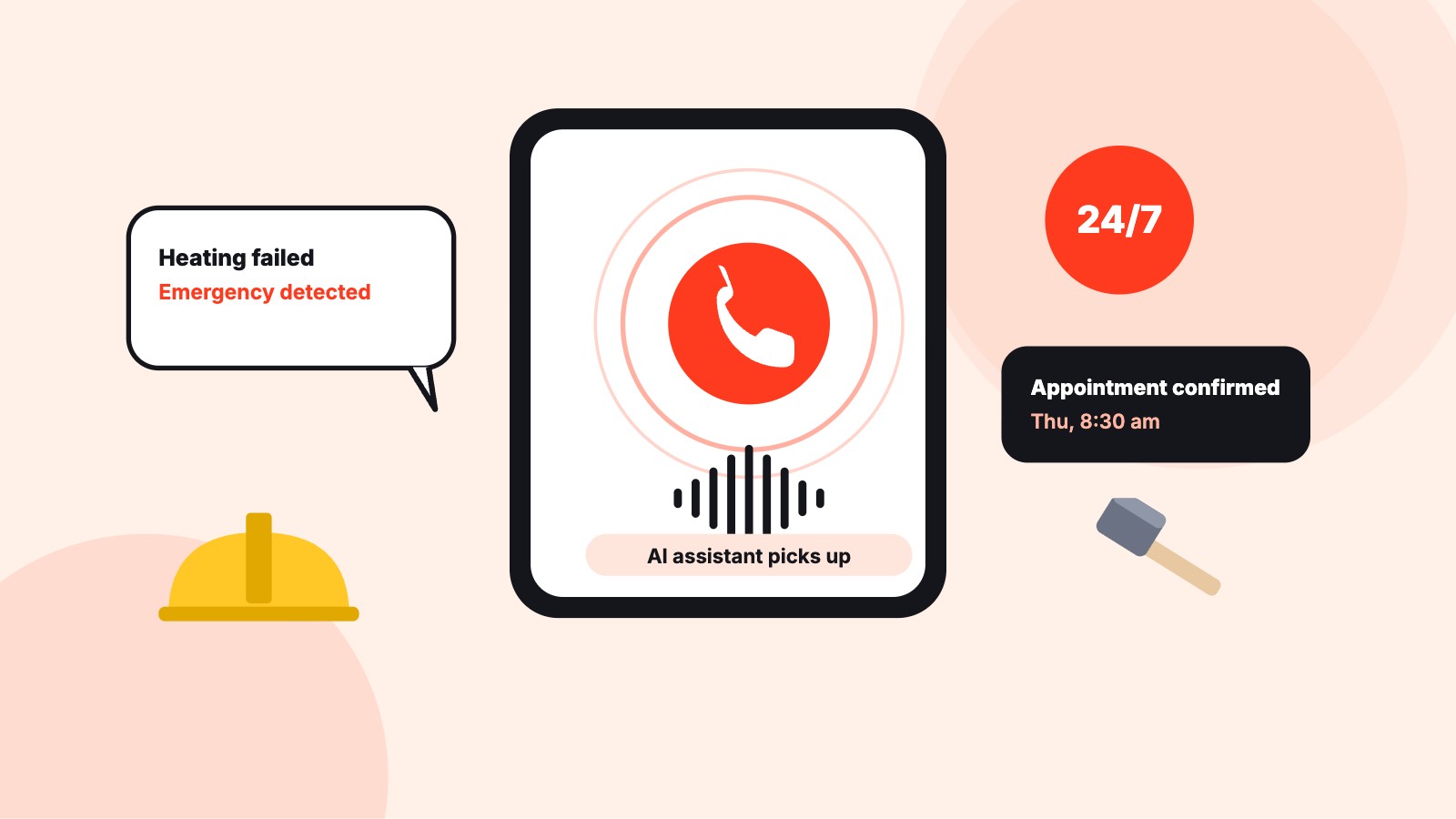
A phone AI for tradespeople answers calls when the boss and fitters are out on the job site, and handles the standard conversations itself. For a business without its own office staff, it is usually the cheapest way to stay reachable. It costs only a fraction of a full-time hire and never lets a caller run into silence again.
What an AI phone assistant actually handles in day-to-day trade work
An AI phone assistant takes over the calls that today land on the boss's mobile or go unanswered: appointment requests, emergencies, quote requests and standard questions. Technically, it is a voice agent, meaning software that speaks with a natural-sounding voice, captures the request during the conversation and either handles it itself or passes it on in a targeted way. In a trade business, these are mainly the following tasks:
- Booking appointments: the AI suggests free time slots, schedules maintenance visits and reschedules existing appointments during the call.
- Prioritizing emergency service requests: the AI recognizes a burst pipe or heating failure, asks targeted follow-up questions and immediately transfers to the on-call phone.
- Taking quote requests: for renovations, the AI captures the address, room size, time frame and best time for a callback.
- Answering standard questions: the AI clarifies service area, opening hours and services without a callback.
- Promising callbacks: if someone wants to speak to a person, the AI takes name, number and reason for calling.
The difference from today's routine is the time of day. The AI also works evenings, weekends and public holidays, and that's exactly when customers with a heating failure or water damage call. You define in advance which descriptions count as an emergency, for example "water is leaking" or "heating completely off in freezing weather". Everything else ends up as a request for the next working day.
These workflows are covered by ScaleTalk's AI phone assistant for tradespeople: it answers calls around the clock, schedules appointments and forwards emergencies, even while your team is on the job site.
What does an AI phone assistant cost a trade business per month?
For most small trade businesses, an AI phone assistant stays under €100 net per month, only high-volume packages cost up to around €300. The price is determined mainly by call volume; the number of employees hardly matters.
| Model | Monthly price | What is included | Best for |
|---|---|---|---|
| Typical market entry-level models | €39 to €89 net | Limited allowance depending on the provider | Small businesses with modest call volume |
| Upper market segment | up to about €299 net | Higher allowances, more integrations | Businesses with high volume or multiple locations |
| ScaleTalk Start | from €99 | 500 call minutes, unlimited parallel calls and agents | Small and mid-sized businesses without emergency service |
| ScaleTalk Growth | from €249 | 1,400 call minutes, personal onboarding | Businesses with emergency service or a busy heating season |
| ScaleTalk Scale | from €499 | 3,200 call minutes | Larger businesses with multiple crews |
| ScaleTalk Enterprise | custom | from 5,000 call minutes | Very high call volume |
There is no official price statistic from trade chambers or associations for these products. The market range comes from provider market overviews and comparison sites, which are in the same ballpark.
A rough calculation shows which plan fits: at an average of three minutes per call, 500 minutes cover just over 160 calls per month, or about eight per working day. Anyone offering emergency service or getting significantly more calls in winter is more likely to land on Growth, which covers just over 450 calls at the same call length. Because ScaleTalk plans come with no hidden costs and can be cancelled monthly, a wrong estimate can be corrected without a long commitment.
What drives the price: Minute allowance, call capacity, integration and onboarding. Check whether these are included in the base price or cost extra.
AI phone assistant, office clerk or external answering service: the cost comparison
Compared with an office clerk and a classic answering service, the AI assistant is the cheapest option at normal call volume, especially when availability outside working hours is needed. Current market overviews give these orders of magnitude:
- Own office clerk: €2,500 to €4,500/month including ancillary costs; part-time €1,500 to €2,000, only during business hours.
- External answering service: €150 to €500/month plus €1 to €3 per call, surcharges for nights and weekends.
- Pay-per-call: with 20 calls at €1.70, about €34 net/month with no base fee.
The pay-per-call model, billing per answered call, is indeed the cheapest for businesses with very few calls. With every additional call, however, the bill rises linearly, while the AI plan stays the same. For a business that misses several calls a day during heating season, the math tips quickly.
What matters economically is the revenue side. The common rule of thumb: even one additional job won per month pays back the cost of an AI phone assistant several times over, because typical job values in the trades are several hundred to a thousand euros. A customer with a broken heating system who gets through on the first try doesn't call a second business.
For higher volumes, a ScaleTalk case study from another industry shows the order of magnitude: the company previously paid €1,800 per month for its call center and afterwards around €250, with roughly 850 automated calls per month. That equals a saving of 86 percent.
Setup without an IT department: how fast is a phone AI ready to go?
A phone AI is ready to go without programming skills: the setup itself takes a few minutes, and ScaleTalk builds a ready-made basic agent from your website within 24 hours. The process looks like this:
- Create a free account, no credit card needed.
- Enter your website: ScaleTalk builds the free AI assistant for your business from it.
- Test it, then set emergency criteria, forwarding numbers and greeting.
- Go live via call forwarding in your phone system.
Most businesses set up call forwarding in their existing system or in their phone provider's customer portal. If you use the cloud phone system fonial with native ScaleTalk integration (from €3.90 per month), you largely skip this step and receive discounted introductory terms for the first months.
Booked appointments flow into a connected calendar. Whether your specific trade software for jobs and dispatching can be connected directly is best clarified in a demo: bring the names of your programs.
Data protection and customer data: what GDPR compliance means for your business
GDPR compliance means for your business: name, address, phone number and damage description from the call are processed exclusively on your behalf and according to your instructions. ScaleTalk is 100% GDPR compliant, the servers are in Frankfurt, the product is made in Germany. Your customers' call data therefore sits in a German data center and is subject to German and European data protection law.
Data processing agreement: A written contract (DPA) defines purpose, security, retention periods and subcontractors. You remain responsible, the service provider acts on your instructions.
Two steps remain for you: before starting, you sign the DPA with the provider, and you add a paragraph on AI call answering to your privacy policy. You can find the wording of the obligations in the legal text of the General Data Protection Regulation. For a trade business, the effort is manageable, compared with the notepads and private mobiles where customer data often ends up today.
When the AI doesn't know what to do: handing over to the boss or an employee
When the AI reaches its limit, it hands the call over, following rules you define yourself. Typical triggers for this escalation are a detected emergency, a complaint, an explicit request for a human, or a request that remains unclear even after follow-up questions. The AI then transfers directly to the on-call phone or the office. If nobody is available there, it takes name, number and reason for calling, promises a callback and sends you the note. The customer hangs up with a clear commitment.
How customers experience the AI depends heavily on the implementation. Callers in the trades mainly want someone to pick up and their problem to get through. A short, honest greeting, a calm voice, short questions and the option to ask for a human at any time take away the hesitation, even for older customers. What looks unprofessional is rather the opposite: an answering machine as the only response on a Friday afternoon.
Example greeting: "Hello, this is the digital assistant of Haustechnik Becker. I'll connect you to our team if needed. What is it about?" The caller knows right away who they are speaking to and that a human remains reachable.
Realistic limits remain, though. Strong dialects, noisy surroundings or very confused descriptions tend to lead to follow-up questions. The AI should not quote binding prices for a repair; that belongs in the quote after an inspection. And the answers are only as current as the knowledge base, meaning the information the AI draws from. Listen to the call logs regularly in the first two or three weeks and fine-tune. After that, a quick look when something changes in the business is enough.
Which trades and business sizes benefit most
Trades with emergency service and strongly fluctuating call volume benefit most, meaning businesses where a missed call immediately goes to the competition. Usage patterns differ by trade:
- Plumbing, heating, air conditioning: the AI separates emergencies from maintenance requests in heating season.
- Electricians: many short appointment requests can be scheduled directly without a callback.
- Construction and finishing trades: the AI collects key project data upfront and books consultation appointments automatically.
- Roofers: after storms, the AI takes several damage reports in parallel.
For business size, what matters less is headcount than whether someone is permanently sitting at the phone. In businesses without their own office staff, the phone regularly falls through the cracks between job site and workshop, but a full-time office hire doesn't pay off yet. Solo businesses with only a handful of calls per month should do the math soberly, because there a pay-per-call service can be cheaper. Businesses with an office use the AI as overflow when all lines are busy, and as an evening service. Here, every additional job won from after-hours time pays off directly.
Using reachability as a competitive advantage
Whether the switch pays off in euros and time depends on your call volume; setup without IT skills is the smaller hurdle. As a next step, estimate your monthly call volume: count missed and answered calls for a week, extrapolate to a month and compare the result with the minute allowances in the plan table.
If your volume is in this range, the free basic agent built from your website is the simplest test: you hear how your business sounds on the phone before you decide on a plan.
Frequently asked questions about phone AI in the trades
Three details are enough: your estimated call volume per week, the descriptions that count as an emergency for you, and the names of your calendar and job management software. That lets us show directly in the demo which plan fits and what call forwarding looks like for your business.
Step by step: first only route after-hours calls and unanswered daytime calls to the AI. After two or three weeks of refined answers, you can expand its use, for example to busy lines during heating season.
The phone AI holds a real conversation, an answering machine only records. It books appointments, asks targeted questions about emergencies and transfers the call when needed. Many callers don't leave a message on an answering machine at all and simply call the next business.
Never miss a call again, try ScaleTalk for free now
AI phone assistant for trade businesses, GDPR compliant and set up by yourself without code. Servers in Germany.