

AI Calls in Everyday Business: Costs, Benefits and GDPR at a Glance
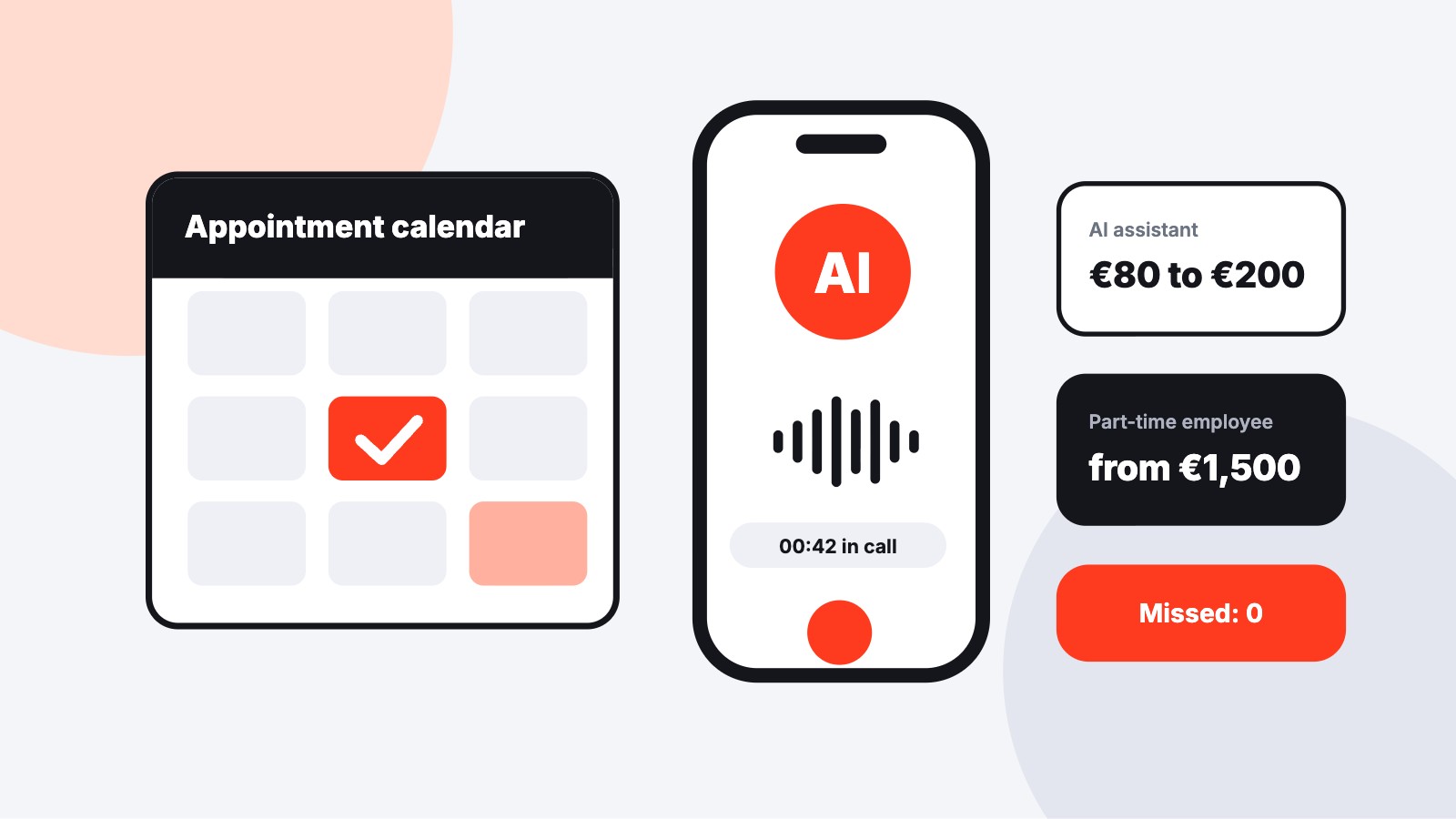
An AI call in everyday business means that software answers your company's incoming calls around the clock, clarifies the request and books appointments into the calendar. For practices, workshops, law firms and agencies with a busy phone, this typically costs €80 to €200 per month plus a one-time €200 to €500 setup fee and replaces voicemail and callback lists in the evening and on weekends.
What does the AI do on the phone, and where does a human take over?
The AI answers the call, states your company name and asks about the reason for calling. From the answer, it recognizes what it is about: appointment request, question about opening hours, status inquiry, damage report or emergency. It handles standard cases itself, for example booking the workshop appointment directly into the calendar or rescheduling the check-up at the orthodontist. Everything else it captures in a structured way. Name, callback number, reason and urgency land as a summary with the team, which no longer has to listen to voicemail messages.
The limit lies where a call requires judgment, liability or tact. The AI should transfer these cases immediately or mark them as an urgent callback:
- Emergencies such as burst water pipes, heating failure in winter or acute complaints at the practice
- angry callers who clearly want to speak to a person
- complex legal, contractual or technical questions, for example on coverage of a loss or a deadline
- Payment data such as credit card or account numbers
- Callers who explicitly ask for a specific employee
Well-configured systems transfer such calls to a fixed number, such as the emergency service mobile, and err on the side of handing over to a human too often. ScaleTalk covers this workflow as an AI phone assistant: it answers calls around the clock, books appointments and qualifies inquiries. The solution as an AI phone assistant for trade businesses schedules appointments and forwards emergencies, even when the team is out on the job site.
What does an AI phone assistant really cost, and is it worth it compared with an answering service or a part-time employee?
For small and mid-sized businesses, an AI phone assistant in Germany costs €80 to €200 per month, plus usually a setup fee of €200 to €500, with some providers from around €100. The overall market range runs from roughly €30 to €500 per month (as of 2026).
The scope of functionality is decisive: entry-level plans for €29 to €80 take messages and answer frequent questions. True appointment booking with calendar integration starts at around €80 and goes up to about €250, packages for multiple locations are above that. For most practices, workshops and agencies, the middle range is the relevant one, because without a calendar, the biggest lever is missing.
How the price is made up depends on the billing model. With per-minute pricing, you pay a base fee plus around €0.10 to €0.30 per call minute. Most common among SMEs is the flat rate with a bundle of free minutes, because it makes costs plannable. Pay-per-use without a base fee bills per call, typically at €0.20 to €0.30. That only suits a few, irregular calls and quickly becomes more expensive than a flat rate as volume grows.
Compared with the two classic alternatives, the picture looks like this:
| Solution | Cost per month | 24/7 availability | Billing | Calendar access |
|---|---|---|---|---|
| AI phone assistant | €80 to €250 plus one-time setup | Yes, even with several calls at once | Flat rate, per-minute or per-call pricing | Yes, in SME plans |
| External answering service | €150 to €800 | Mostly only during business hours | Per call | Mostly no |
| Part-time receptionist | €1,500 to €2,000 incl. social security contributions | No, about eight hours a day, no weekends | Salary | Yes |
The part-time employee remains sensible when reception handles more than phone calls, such as patient intake or checkout. For pure call answering, especially evenings, weekends and peak times, the AI pays off as soon as a few jobs are saved. When comparing specific packages, included minutes, the price beyond the allowance and the setup fee count. These points can also be used to assess ScaleTalk's AI phone assistant.
What missed calls actually cost a business
Missed calls cost money because callers don't call back when they can't reach anyone. In an international study of 85 small businesses from 58 industries, an employee answered only just under 38% of calls. Depending on the study, 30 to 62% remain unanswered; for the German trades, 30 to 40% is considered a benchmark. Around 80% of callers who reach a voicemail hang up without leaving a message, and most turn to another provider.
Model calculation for missed calls
There are no representative surveys specifically for Germany. The following calculation is therefore a model calculation with international benchmark values, which you should fill with your own numbers.
Model calculation: 10 missed calls per week × 30% close rate × €300 order value × 52 weeks = €46,800 in lost revenue per year. For your business: value of a call = (monthly revenue ÷ incoming calls) × close rate.
On top of that comes working time. Anyone who spends 45 minutes a day on callbacks ties up, at an hourly rate of €50, around €750 per month, without generating an additional job. How strongly the calculation swings depends on the order value. An emergency call-out for heating, electrical or plumbing brings in about €750 on average, a physiotherapy appointment €30 to €80.
For a real estate agent, a lost prospect can cost a commission of an average of just under €18,000. In physiotherapy, what matters is therefore mainly relief at reception. In emergency service and in a real estate office, even a single saved call counts.
Is AI call answering GDPR compliant?
Yes, AI call answering can be operated in a GDPR-compliant way. The company remains the controller under the GDPR, the provider processes the data on its behalf. That means all mandatory points lie with your business, including the choice of server location.
Data processing: A service provider that processes personal data on your instructions is a processor under Art. 28 GDPR. For AI call answering, this covers names, callback numbers, reasons for calling and, where applicable, audio recordings. Without a written data processing agreement (DPA), use is not permitted, regardless of price and technology.
For medical practices, home care services and anyone who hears about complaints or treatments on the phone, Art. 9(2) GDPR also applies. Health data counts as special categories of personal data and needs, in addition to Art. 6, a separate legal basis. Define with your data protection officer which details the AI should ask for at all. For booking an appointment, the reason in rough terms is often enough. For the call content itself, the secrecy of telecommunications under § 3 TDDDG also applies in Germany, even if the processing is automated.
On top of that comes the EU AI Act, which as EU law applies directly in Germany as well. From August 2, 2026, Art. 50 of the AI Act requires that callers learn right at the start that they are speaking with an AI. On the phone, this can practically only be solved with a spoken announcement. For selection and setup, that means concretely:
- The DPA is signed before the start, including a list of the subprocessors involved.
- The servers are in Germany or the EU, which avoids third-country transfers and simplifies documentation.
- A spoken announcement tells callers at the start of each conversation that an AI is responding.
- A structured summary replaces the audio recording, which otherwise needs its own legal basis and notice.
ScaleTalk is designed for 100% GDPR compliance, is audited by DataGuard by its own account and is Made in Germany. A server location in Frankfurt covers one of the four points that you check and document when choosing a provider. The DPA, the announcement and the handling of recordings you additionally clarify with the provider as the responsible business.
Setup in practice: phone number, calendar, phone system
Your number stays the same. In your phone system or with your network operator, you set up call forwarding to the AI assistant's number, either permanently, time-controlled or only when the line is busy. A number port, meaning moving the number to a different phone provider, is only needed if you switch your entire telephony.
You complete the basic setup with greeting, opening hours, frequent questions and forwarding numbers in ScaleTalk within a few minutes without programming skills. For fine-tuning the conversation rules and first test calls, you should plan a few days of test operation. Depending on use, the assistant needs these connections:
- Call forwarding or SIP connection (standard protocol of internet telephony) to the existing phone system
- Calendar or appointment software so the AI sees free times and books directly
- Practice, workshop or CRM software if requests should land in the customer record
- Email or messenger for callback summaries to the team
- Fixed forwarding numbers for emergencies and transfers
If you are looking for a new cloud phone system anyway, with fonial you will find a system from €3.90 with queues, native ScaleTalk integration and skill routing, meaning the distribution of calls by responsibility.
The voice decides. In a Bitkom survey, 89% of consumers said they first pick up the phone when they have a problem. For them, the AI is the first voice of your business. So test with real calls, including dialect, background noise and interjections. Pay attention to the latency, the pause between question and answer.
Have them show you how the handover to humans is configured and which calendars can be connected. Finally, clarify the contract term and trial phase: a solution that can be cancelled monthly without a hardware purchase keeps the risk small.
The answer in four weeks
What matters is which calls need which channel. The AI can reliably take over appointment requests, status questions and callback requests; emergencies and delicate conversations stay with the team. So start with low risk and switch the AI on first in the evenings, on weekends and for overflow. Record three values beforehand and compare them after four weeks:
- The share of answered calls among all incoming calls.
- The daily time your team spends on callbacks.
- The number of appointments or jobs that came about outside opening hours.
If the value of the additional jobs and the saved callback time exceeds the monthly fee, gradually extend the hours of use. A demo with your own call scenarios shows in advance how this sounds in your business.
Frequently asked questions about AI calls
Briefly and right at the start, for example: "Hello, this is the digital assistant of Praxis am Markt, how can I help?" A sentence like this meets the transparency requirement and sounds friendlier than a formal legal notice. It has to be said before the substantive conversation begins.
In the worst case, the call ends up with the team as a normal callback request. So store typical emergency terms for your industry such as "water is leaking" or "severe pain". In addition, every caller who says something like "I want to speak to a person" should be transferred immediately.
Usually yes, because the basic connection runs via simple call forwarding, which almost every system and network operator offers. For targeted transfers to individual employees, a cloud phone system with direct integration is more convenient.
With a short greeting, few follow-up questions and a human who is reachable at any time. Frustration arises mostly in loops where the AI repeats the same question. In the first weeks, review the call summaries and adjust the wording in a targeted way.
Avoid missed calls, try ScaleTalk for free now
AI telephony for practices, workshops, law firms and agencies, set up in a GDPR-compliant way. Servers in Germany.