AI phone assistant for medical practices: costs, setup and GDPR in 2026
An AI phone assistant answers calls around the clock, schedules appointments and answers routine questions. What it costs practices, how setup works, and what GDPR and medical confidentiality require.
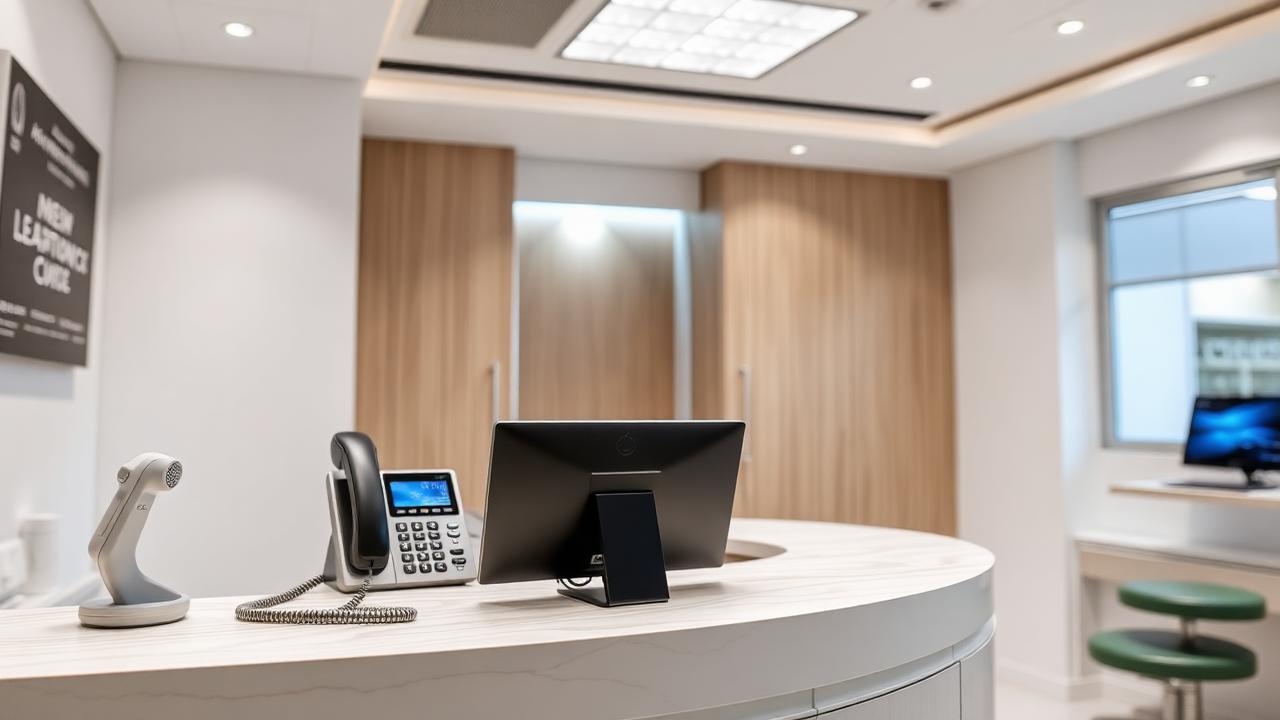
An AI phone assistant for medical practices answers incoming calls around the clock, schedules and reschedules appointments in the practice calendar and answers routine questions about prescriptions, referrals and opening hours. Practices usually pay a base fee of €69 to €199 per month plus a small fee per call minute, and setup works without an IT department in under an hour.
To practice owners and medical assistants, this initially sounds like yet another digital tool. In reality, it targets exactly where daily practice life eats up the most time: the constantly busy phone that has been paralyzing the front desk and reception for years.
- According to the provider (Doctolib/Aaron.ai), German practices receive an average of 950 to 1,000 calls per month, tying up around 45 working hours.
- Depending on time of day and practice size, 30 to 40 percent of all calls go unanswered.
- An AI phone assistant usually costs practices €69 to €199 per month plus a per-minute rate.
- In addition to the data processing agreement under GDPR, a confidentiality obligation under Section 203 of the German Criminal Code (StGB) is also required.
What does an AI phone assistant concretely handle in daily practice?
In a medical practice, an AI phone assistant handles exactly the calls that currently tie up the front desk and medical assistants. It runs alongside the front desk during consultation hours and as the sole call answerer outside them, so no call goes unanswered anymore.
Providers such as Doctolib describe this range of functions as the typical core of practice use. Prioritization is what matters: if the assistant recognizes an urgent medical concern from keywords such as "severe pain" or "shortness of breath", the call is transferred immediately. Emergencies are never handled automatically; they always end up with a human.
Good to know: The assistant pre-filters rather than replacing staff. Simple, recurring requests run automatically; everything that needs judgment goes on to the practice team.
How many calls does a practice miss each day, and what does that cost in appointments?
An average practice loses an estimated 15 to 30 calls per day because all lines are busy at the time of the call, with a clear peak in the first hour after the practice opens. That is shown by benchmarks from phone system manufacturer Agfeo for small to mid-sized practices.
Extrapolated to a month, this matches the order of magnitude Doctolib cites when introducing its AI phone assistant Aaron.ai: practices receive 950 to 1,000 calls per month, tying up around 45 working hours, and according to the manufacturer three out of four calls go unanswered. As a high-reach provider with over 16,000 connected doctors and 3 million calls per month, this figure is meaningful, but it remains a provider claim and not an independent study.
More cautious but still high figures come from a summary of surveys by the regional associations of statutory health insurance physicians: on average, 30 to 40 percent of all incoming calls go unanswered, and at peak times such as Monday mornings, after public holidays or during cold season, the rate rises to as much as 50 percent, as an analysis by DigitalRezeption summarizes.
What this means for the practice becomes visible in patients' reactions: if no one answers the phone, according to industry analyses of search behavior, a large share of callers move on to the next practice. Every missed call is therefore potentially an appointment that never makes it into the calendar, and a patient who calls somewhere else next time. For the front desk, the same number of calls with unchanged staffing means noticeably more pressure, especially since the medical assistant profession is listed as a shortage occupation by the Federal Employment Agency and increasing staff is rarely possible at short notice.
What does an AI phone assistant for medical practices cost in 2026?
An AI phone assistant for medical practices in Germany usually costs between €39 and €500 base fee per month, plus €0.15 to €0.50 per call minute once the included allowance is used up. For most solo and group practices, the realistic range according to a market overview is €69 to €199 per month.
Specialized providers for medical practices position themselves differently within this range: 321 MED starts at €139 per month, the CGM TelefonAssistent ranges from €199 (up to 1,000 calls) to €699 per month for a flat rate without CGM practice software, and Dr.wait starts at €99. Most contracts can be canceled monthly; multi-year commitments are rather the exception in this market.
ScaleTalk tiers its plans by call minutes rather than by feature scope and thus covers different practice sizes, from solo practices to group practices with high call volume. If the included minutes in a plan are not enough, auto-recharge lets you top up 250 additional minutes for €50. All plans can be canceled monthly, there is no setup fee, and unlimited parallel calls as well as any number of agents are already included.
| Provider/plan | Monthly base fee | Included volume |
|---|---|---|
| Dr.wait | from €99 | depends on provider |
| 321 MED | from €139 | depends on provider |
| CGM TelefonAssistent | €199 to €699 | up to 1,000 calls / flat rate |
| ScaleTalk Start | €99 | 500 minutes |
| ScaleTalk Growth | €249 | 1,400 minutes |
| ScaleTalk Scale | €499 | 3,200 minutes |
Price factors that drive monthly costs: The practice's call volume, depth of the practice management system (PVS) integration, number of parallel lines and whether a setup fee applies. If you run multiple locations, clarify in advance whether the plan is billed per practice or per call volume.
How does the assistant connect to practice software and appointment calendars?
An AI phone assistant enters booked appointments directly and bidirectionally into the existing practice management system, so the front desk and doctors see the current calendar status without extra effort. According to a market overview, modern solutions can connect to common systems such as CGM, Medistar, Medatixx, tomedo or Doctolib.
Important for the purchasing decision: integration depth differs significantly between providers. Some solutions only sync with an external, separately managed calendar, while others write directly back into the PVS and thereby also automatically update waiting times, practice capacity and consultation hours. Before signing, the practice should therefore ask specifically whether the connection works read-only, write-only or fully bidirectionally, and which PVS version is required.
Is an AI phone assistant compatible with GDPR and medical confidentiality?
An AI phone assistant is only permissible in a medical practice if two legal layers are satisfied at the same time: GDPR via a data processing agreement (DPA) under Art. 28 GDPR, and medical confidentiality under Section 203 StGB. The two requirements complement each other but do not replace each other.
The highest data protection requirements of all apply to calls in a practice: health data falls under Art. 9 GDPR as a special category of personal data. Before introducing a provider, processing within the EU, a DPA with documented subprocessors and clear deletion periods must therefore be settled in writing.
The part many practices overlook concerns confidentiality: according to a legal assessment of cloud AI in medical practices a DPA does not solve the criminal law problem of Section 203 StGB, because confidentiality can't be circumvented by a contract between doctor and IT service provider. Since the reform of Section 203 StGB in 2017, doctors may involve external IT and cloud service providers as "persons assisting in the professional activity", but only if these are bound to secrecy by contract and with documentation.
DPA and Section 203 obligation compared: The DPA governs what may technically and organizationally happen with the data and is mandatory under GDPR. The obligation under Section 203 StGB protects the relationship of trust between doctor and patient under criminal law and applies indefinitely, even beyond the end of treatment. For every external service provider with access to patient data, the practice needs both documents.
How pressing the topic is in practices is shown by a Bitkom/Hartmannbund survey of 616 physicians from May 2025: 15 percent of practices already use at least one AI solution, 8 percent of them specifically in appointment management and practice organization. In the same survey, 59 percent of doctors consider the interpretation of data protection in healthcare too strict, while 76 percent at the same time call for strict regulation of AI in medicine. Taken together, both values suggest that for many doctors it is less about the data protection standard itself than about its practical handling in daily work.
GDPR evidence a practice should demand before signing: Server location in Germany or the EU, a DPA under Art. 28 GDPR with a list of subprocessors, documented technical and organizational measures (TOMs), a written exclusion of model training with patient data and a separate declaration of obligation for "persons assisting" under Section 203 StGB. ScaleTalk processes calls on servers in Frankfurt and provides the DPA and documentation as a made-in-Germany provider; the details should nevertheless be reviewed individually for each practice.
How does setup work, and how long does it take?
A practice sets up an AI phone assistant without programming skills and without its own IT department, with ScaleTalk in 30 minutes according to the manufacturer. The front desk and practice management usually go through the same steps:
Opening hours, consultation hours, the list of doctors and standard answers are entered in the dashboard.
The practice management system or an external appointment calendar is linked via an interface.
Which requests run automatically and which keywords trigger a transfer to a human.
The existing practice number is routed to the assistant, either only outside consultation hours or continuously.
A short trial run shows whether appointment logic and transfers work as desired, after which the practice is live.
For the front desk, this means in day-to-day terms: no waiting for an IT service provider, no multi-day training. The practice team switches over during normal operation, and the previous phone route stays unchanged for patients, except that the line on the other end is now rarely busy.
What the effort really delivers in the end
In the end, what matters less is what the software costs than how many appointments are lost to missed calls, measured against the cost of an additional practice employee. With 30 to 40 percent of calls unanswered, an investment of €100 to €250 per month usually pays off as soon as it results in a few additional appointments per week.
For the practice team, the noticeable effect often lies elsewhere: fewer interruptions during front desk work, less pressure in the first hour after opening and more time for patients who are actually standing in the practice. In times of medical assistant skills shortage, this can make a noticeable difference in daily life for many teams.
Many phone systems already show missed calls.
Compare by minute allowance and depth of PVS integration.
Only then decide on concrete compatibility with your own PVS.
If you want to see how a practice has made the switch in concrete terms, you will find it in the ScaleTalk case study on practice use, and the industry page for medical practices additionally shows which functions are available. That the basic model works across industries is shown by comparable implementations for tradespeople, where the same relief in call answering and appointment booking becomes measurable.
Frequently asked questions about AI phone assistants in medical practices
Yes, reputable providers recognize urgent medical concerns from stored keywords such as severe pain or shortness of breath and immediately transfer the call to an available staff member or the doctor. This detection logic should be discussed with the provider using concrete example cases before signing.
No, a DPA under Art. 28 GDPR only covers the data protection side. In addition, the practice needs a separate, documented obligation of the provider under Section 203 StGB, as otherwise medical confidentiality remains unresolved.
Even with the 15 to 30 missed calls per day mentioned for an average practice, a plan from around €99 per month often pays for itself through a few additionally retained appointments per week. The larger the practice and the fuller the appointment calendar, the faster the investment pays off.
No, the existing practice number stays the same and is simply routed to the phone assistant, either continuously or only outside consultation hours. Nothing changes for patients in how they dial, and even if you switch providers later, the same number can usually be kept without problems.
Yes, setup is deliberately designed so that it can be completed in under an hour without programming skills and without an IT department. Practice data, calendar connection and conversation guides are set up via a dashboard that medical staff can also operate without technical background.
Take the load off your practice phones: try ScaleTalk for free
AI telephony for medical practices, set up in a GDPR-compliant way and ready in under an hour. Servers in Germany.